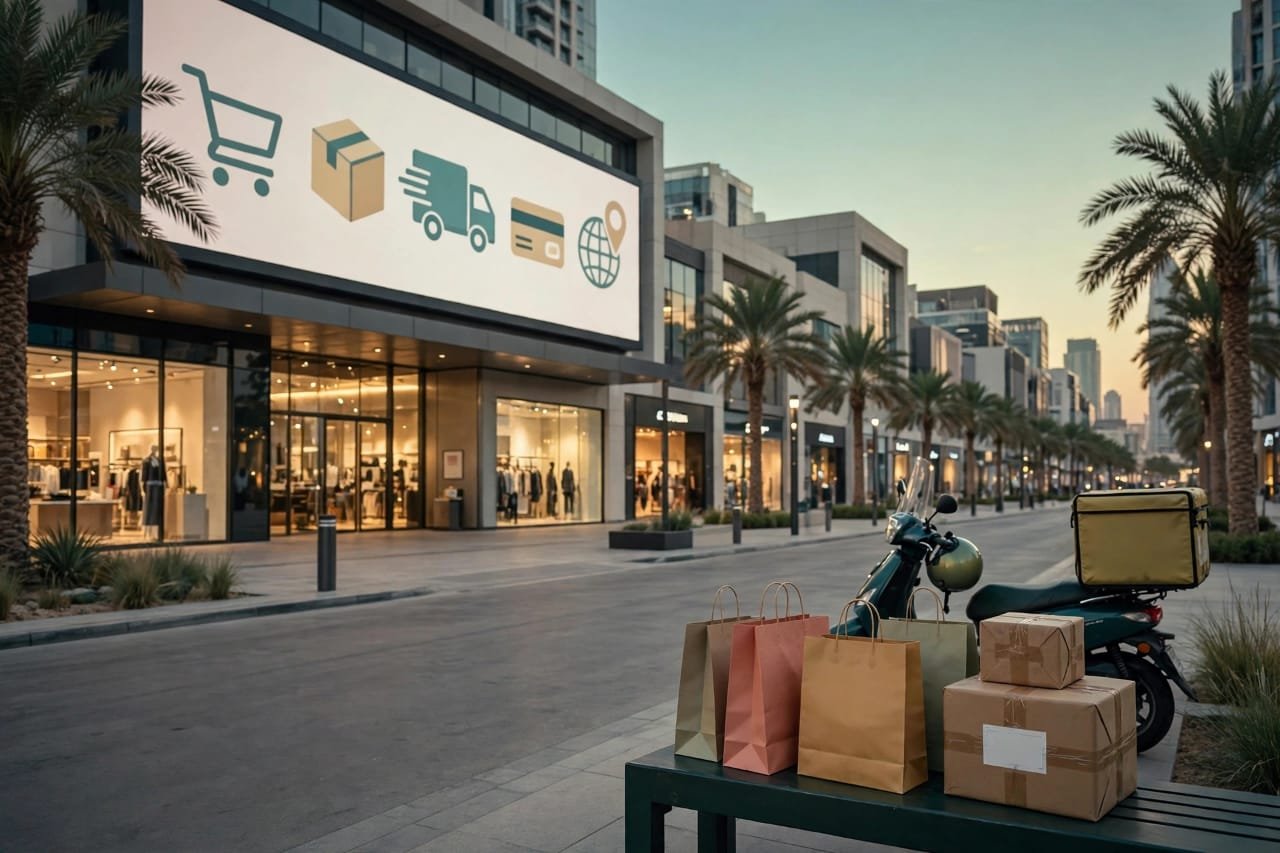
The UAE retail industry is undergoing a transformation where consumers are increasingly shopping online, demanding quicker service, and seeking more convenient options for buying goods and services. Being familiar with the retail trends UAE 2026 gives retailers, e-commerce businesses and shopping centres a better chance to adjust their plans and strategies to customer expectations.
According to the e-commerce analytics firm, EZDubai and Euromonitor International, the UAE’s e-commerce market hit AED 42.2 billion in 2025. It is forecast to reach AED 67.2 billion by 2030. The growth underscores the rise of digital commerce as an important complement to brick-and-mortar retail.
Major Retail Trends UAE 2026 Businesses Should Watch
1. Online Shopping Continues to Expand
E-commerce is still playing a significant role in the UAE retail sector. There are more and more shopping platforms available online that allow consumers to compare prices, research products, and order online.Shopping platforms online are growing increasingly which allow consumers to compare the prices, research for products and order online.
Retailers should invest in an E-Commerce website that is compatible with the mobile browser, a smooth checkout process, product descriptions that clearly and accurately explain products, and a reliable delivery service. Platforms such as Amazon.ae and Noon also provide businesses with access to online shoppers.
The most recent market data indicates that e-commerce has made up around 15.7% of retail sales in the UAE in 2025. This percentage will be more than 20% by 2030.
2. Omnichannel Retail Connects Online and Physical Stores
Not all customers’ shopping trips are from one store to another. They might find a product on Instagram, do some online shopping, head to a store and make their purchase using an app.
Thus, omnichannel retail strategies in UAE have become more relevant these days. Retailers can link their brick-and-mortar outlets, websites, mobile apps and customer service to deliver a uniform customer experience.
Click-and-collect services, online stock availability, unified loyalty schemes and flexible returns for all channels are options that can be useful.
3. Personalised Shopping Experiences
Customers want to be offered and communicated with about products they are interested in and their shopping habits.
Customer relationship management (CRM) systems and purchase data can be used by retailers to determine preferences and provide appropriate product suggestions. AI tools can also aid in product discovery, customer service and personalisation and promotion.
But, companies must adopt a responsible approach to data collection and processing while ensuring transparency regarding the collection and processing of personal data of their customers.
4. Digital Payments Become Standard
Convenience in payment is a critical aspect of online and in-store shopping. More flexibility for the customers at cards, digital wallets, contactless payments and Buy Now, Pay Later options.
Visa report in January 2026 showed that 80% of payments in the UAE are digital. To minimize checkout hassles, retailers must provide safe payment methods and accept popular payment methods.
5. Shopping Malls Focus on Experiences
The physical retail sector is still important in Dubai retail market. These shops like Dubai Mall and Mall of the Emirates offer entertainment, dining and leisure in addition to shopping.
Retailers have responded in various ways such as enhanced store layouts, interactive product demos, and great in-store experiences. The shopping habits that Dubai stores employ can help them hold on to customers for longer and make them more likely to spend more time looking at the products.
6. AI and Retail Automation Improve Operations
Retailers use AI tools such as inventory management to handle day-to-day operations, including automated customer support and demand forecasting.
Retailers can, for instance, leverage sales data to determine which products are popular, anticipate stocking needs and minimise stock shortages. Automated chat tools can also respond to common customer questions outside of business hours.
Understanding Customer Behaviour in the UAE
Purchase decisions are made throughout the UAE based on price, convenience, product quality and brand trust. In addition, consumers check online reviews, delivery choices and offers before buying.
Tabby reports that 43% of shoppers in the UAE and Saudi Arabia are utilizing AI to make purchasing decisions, and 70% would steer clear of retailers who don’t offer flexible payment methods.Tabby surveyed 20,999 shoppers across UAE and Saudi Arabia and found 43% use AI to assist in making purchase decisions and 70% would avoid retailers who don’t allow flexible payments.
Retailers should, therefore, offer competitive prices, trustworthy service, and clear and accurate product details and payment options.
How UAE Retailers Can Prepare for Future Changes
It is recommended that businesses examine their websites, payment methods, customer information, and delivery methods. It is possible to monitor how many people are making repeat purchases, returning customers, and being converted by measuring online sales and keeping an eye on these metrics.
Retail technology Dubai businesses can use and investing in mobile commerce and connected customer experiences can also facilitate retailers in adapting to evolving shopping preferences.
Conclusion
The retail trends UAE 2026 illustrate a landscape where online commerce and offline retail go hand in hand. Payments, customized offers, delivery and service consistency are what customers look for.
Retailers with a grasp of consumer behaviour and those who take action to make practical digital enhancements will be better equipped to respond to the UAE’s evolving customer landscape.
FAQs
1. What are the major retail trends in the UAE in 2026?
Ecommerce growth, omnichannel shopping, digital payments, the spread of AI, personalised experiences, and experiential retail are key trends.
2. How is online shopping changing the UAE retail market?
Consumers today are more and more comparing products and buying online through mobile apps, websites and marketplaces. Retailers are making it easier to get your clothing and offering quicker delivery times.
3. What is omnichannel retail?
Omnichannel retail integrates the physical store, website, mobile app and customer service channels to allow customers to seamlessly flow from one to the next.
4. How can UAE retailers improve customer experience?
Retailers can provide various payment options, customer assistance, product details, custom recommendations, and delivery/return services.