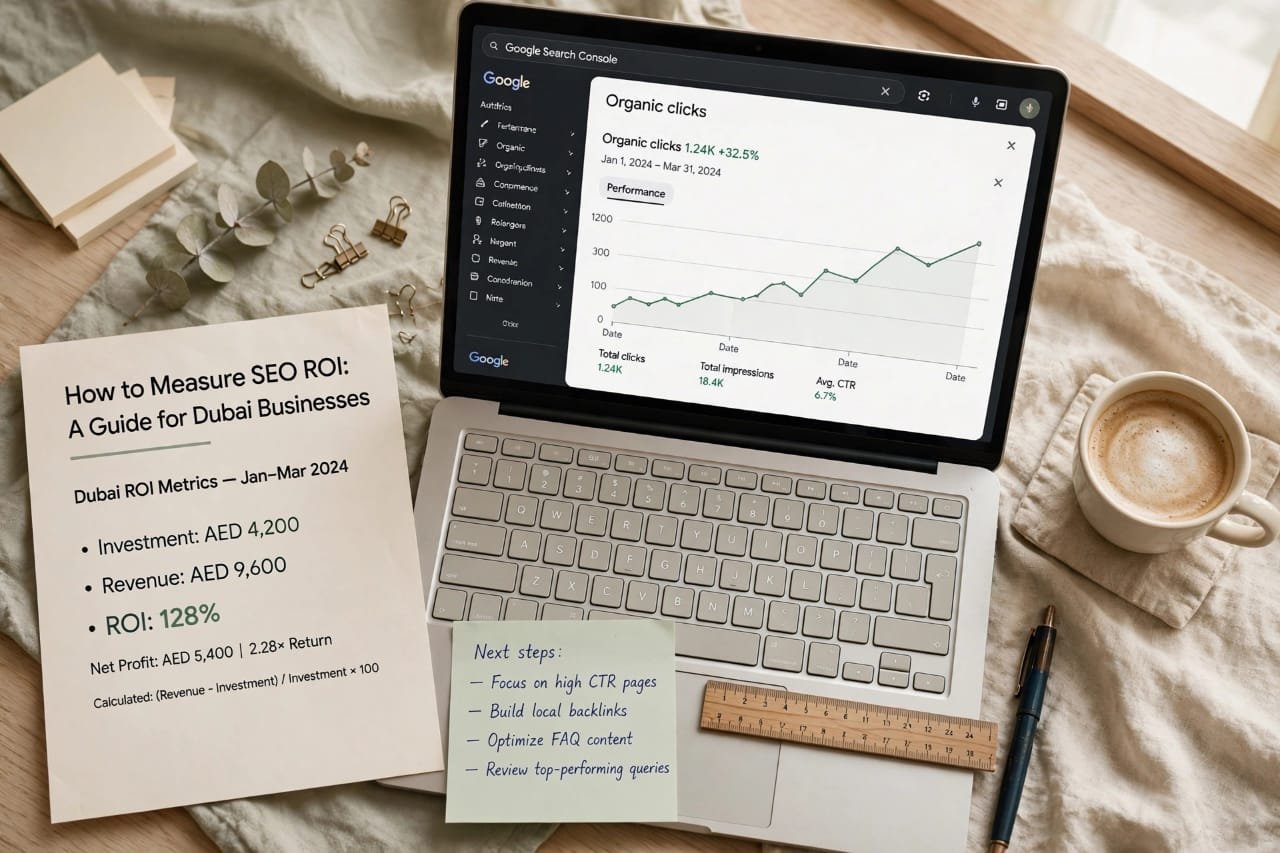
For Dubai businesses and companies, SEO is supposed to make more than traffic to their website. It should drive in quality traffic, boost sales, and drive sustainable growth. Tracking ROI Dubai campaigns enables business owners to determine if their SEO efforts are generating any sort of monetary results.
SEO ROI should be measured by metrics like organic traffic, leads, conversions, revenue and the overall cost of the SEO activities. These figures can be linked to determine which strategies are effective and where they need improvement in order to provide guidance to UAE businesses.
What Is SEO ROI and Why Does It Matter?
SEO ROI is a measure of the profit made from organic search compared to the SEO activity. These expenses may include content creation, technical SEO, link building, agency fees, and SEO tools.
SEO can take time to generate the results which is different from paid advertising. It is important that businesses judge their performance over a number of months, not just the initial ranking changes.
For instance, someone looking for freight forwarding services in the UAE in Dubai could be interested in a logistics company that’s based there. The true value, however, is when those visitors ask for a quotation and become paying customers.
How to Calculate SEO ROI Dubai Businesses Can Use
The formula for calculating SEO ROI is:
SEO ROI = [(SEO-attributed revenue − SEO costs) ÷ SEO costs] × 100
If Dubai business has spent AED 10,000 on SEO during a reporting period and is able to attribute AED 25,000 in revenue, what is the ROI?If Dubai business has paid AED 10,000 for SEO during a reporting period and had AED 25,000 in attributed revenue, what would the ROI be?
It has an estimated SEO ROI of 150%.
This calculation makes the assumption that AED 25,000 is a revenue to be attributed to SEO. In order to determine the profitability more accurately, businesses should consider gross profit (as appropriate) instead of revenues and should take into account all relevant operating costs.
Which SEO Performance Metrics Should You Track?
1. Organic Traffic Growth
Track the users that are coming through organic search using Google Analytics. Compare the monthly and quarterly results and look for any growth patterns.
Google Search Console offers free tools and data such as search impressions, clicks, CTR, and average position. These numbers can help to understand search visibility changes.
Segment traffic by country, landing page and relevant service area for Dubai businesses. Visits from potential customers in Dubai or Abu Dhabi could be more useful than visits from markets that have no relevance.
2. SEO Conversion Tracking
Install conversion tracking for your website’s SEO results to track actions that are important for your business. This could include completed purchases, appointment bookings, quotation requests, telephone enquiries and contact form submissions.
Google Analytics 4 provides businesses with the ability to set up meaningful interactions as key events. Link these events to leads or sales data, where possible to gain insight into what organic traffic can generate and which traffic is not leading to actual business.
3. Organic Leads and Conversion Rate
To figure out the conversion rate, divide the amount of conversion events by the number of organic sessions and multiply by 100.
If, for instance, 1,000 organic sessions lead to 30 enquiries, the session conversion rate is 3%.
Separate qualified leads from general leads. It may be possible to get more revenue from fewer prospects who are relevant than with a lot of prospects who are not relevant.
4. Customer Acquisition Cost
To determine the cost of acquiring customers through SEO, divide the relevant SEO costs by the number of customers that have been acquired through SEO.
When a business invests AED 12,000 and gains 20 new organic customers, their acquisition cost is AED 600 per new customer.
Compare this number to other marketing channels to check the efficiency of it.
How to Track Revenue Attribution Accurately
The revenue attribution aligns the revenue earned with the marketing channel that drove the sales. However, a customer may find a business via Google and then visit it directly and buy after speaking to their sales team.
Get a better holistic view by leveraging Google Analytics 4, CRM records, call tracking, and uniform lead-source labels. Implementing a multi-touch attribution strategy is more likely to reflect the actual sales funnel, as it considers all interactions a customer has with your website before they convert rather than just the last one.
For service companies in Dubai, note source of enquiry and conversions to customers. This method enables UAE SEO reports to be more beneficial for budgetary decisions on a monthly basis.
How Often Should You Review SEO ROI?
Check traffic, rankings and technical problems on a monthly basis. Compare qualified leads, sales and acquisition costs with them. Monthly evaluations can uncover longer-term trends, and you can determine if it is time to refresh content, optimize landing pages, or look at other keywords.
There are many factors that can affect the SEO performance of your website, such as the nature of your business, the amount of competing websites, how well your site is set up and how long your sales cycle is. Do not guarantee any set rate of return or assess performance based on ranking.
Let’s discuss some common questions about tracking SEO ROI.
FAQs About Measuring SEO ROI
1. How long does SEO take to deliver ROI?
SEO timelines vary. There are things that can be improved in weeks; and others that can be improved in months that can be good for business. Monitor against a baseline and realistic business objectives.
2. What is a good SEO ROI?
There is no standard measure. If a profit margin is not big enough, acquisition costs are too high, customer lifetime value is not high enough, or the time needed to recover the investment is too long, you will not have a positive return.
3. Can small businesses in Dubai measure SEO ROI?
Yes. Small businesses can begin by going with Google Analytics 4, Google Search Console, enquiry records, and month-to-month SEO costs. But a complicated reporting platform is not required.
4. Which tools help measure SEO ROI?
Google Analytics 4 will track website activity and crucial events; Google Search Console will report search performance. A CRM can assist link inquiries to qualified leads and finished sales.