
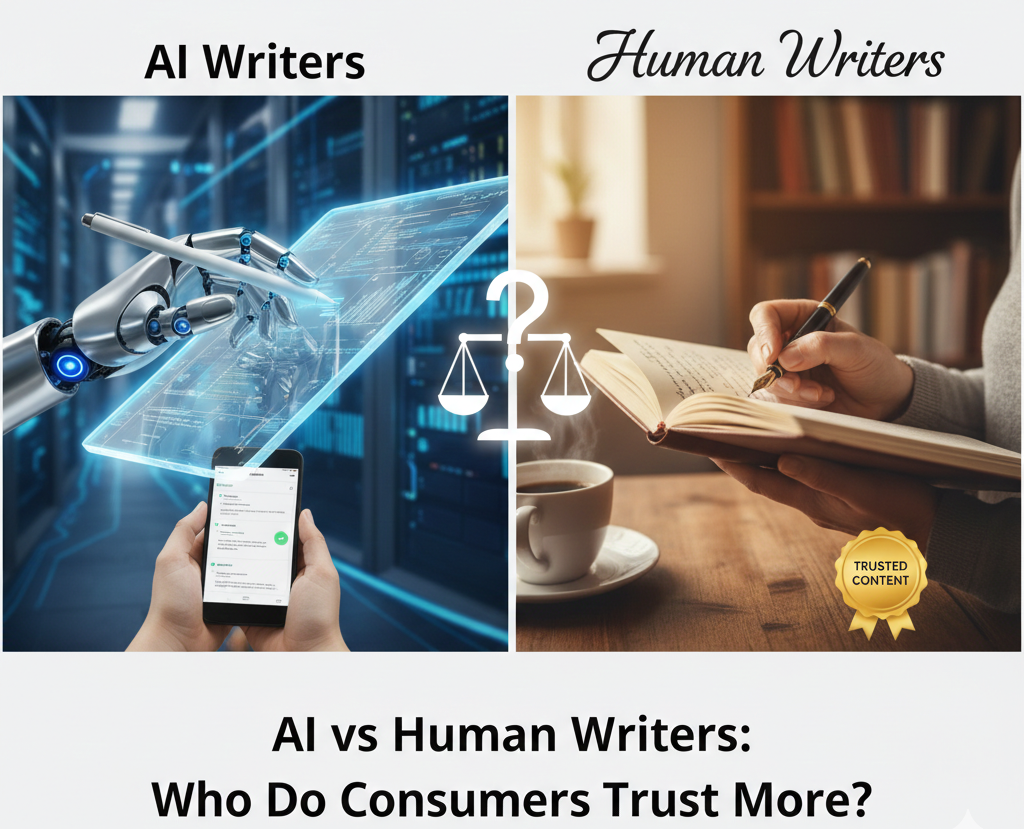
AI vs human writers has transformed the aspects of content creation by the companies, yet it has also triggered the current debate of AI writing vs human writing and which one the audience trusts more. In the case of UAE companies that invest in digital marketing, SEO, and thought leadership, the content credibility AI vs human has a direct impact on the conversion and brand perception as well as the customer loyalty in the long run. It is not only a matter of speed or cost, but also, and most importantly, a matter of trust: do readers trust AI content or human touch remains to be more important?
The solution is that the two possess equal strengths, however, trust in AI generated content is at present more in the hands of human beings. Artificial intelligence material is rapid, scalable, and organized, whereas human beings identify emotional intelligence, cultural appreciation, and experience. This difference is even more significant to content marketing in such a market as the UAE where personal relations are considered highly influential.
Why the Debate Matters for UAE Businesses Today
The discussion between human and AI content trust is relevant today due to the fact that the content purpose has changed. The current use of content does not only serve the purpose of ranking in Google, but also serves to:
- Persuade buyers
- Educate decision makers
- Build brand authority
- Influence long-term loyalty
- Customer care and automation
The UAE real estate, travel, finance, tech, healthcare, logistics, and retail industries rely greatly on consumer trust as a means to transform prospects into customers. When the content is not credible or generic, audiences end up losing attention in a short period.
Do Readers Trust AI Content?
The convenience and clarity of the generated content of AI trust is liked by many readers particularly when it comes to summaries, definitions, comparisons and frequently asked questions. Nevertheless, there is still a lack of AI generated content trust in cases where content needs to be emotional, opinionated, or insight-based. Readers are more skeptical as AI does not have any lived experience, first-hand information, and responsibility.
Ordinary consumer attitudes are:
- AI is not experiential but rather informative.
- AI is monotonous or unspecific.
- AI is impersonal, because it does not have a sense of nuance.
- AI is not emotionally attached.
- AI does not necessarily comprehend culture and context completely.
The confidence in writing by AI versus human is on the rise, but it is not as high as the one with human writing, particularly in the high-impact areas, like investments, travel, or legal counsel where the reader anticipates actual experience and professional opinion.
What Makes Human Content More Trusted?
There is one aspect that human writers have and AI does not, and that is authenticity. The genuine experience, telling, made mistakes professionally, and cultural sensitivity are used to construct authenticity. When an advisor on real estate in Dubai tells how one family navigated off-plan property investments or a travel advisor tells how the weather and prices would be best during certain months of the year, the content of such posts appears to be true because it is coming from someone who has personally seen, done, or tried.
Three things can be used to build trust with human written content benefits:
- Authority: Power is gained in terms of knowledge, case scenarios, experience, and reputation. Human beings have the ability to exhibit authority just by the way they speak and their knowledge.
- Transparency: Readers are at ease when they appreciate that a writer is aware of the dangers, exceptions, or constraints of a subject.
- Accountability: It also makes people aware of the person who offers the advice, which is something that AI cannot provide.
AI Writing vs Human Writing: Key Differences
Although they are both content creators, they work differently.
- Speed: AI can generate content within a few seconds, whereas human beings can do the same task because it involves research, writing, and editing.
- Emotional Intelligence: Audience engagement with content is something that humans comprehend better than machines do due to their tone, humor, complaints, fear, and culture awareness.
- Originality: Artificial intelligence forecasts trends whereas human beings make out of new experiences. This makes human writing more alive and not more monotonous.
- Cultural Nuance: The UAE audiences are sensitive to culture. As an illustration, it is topical to refer to Eid travel trends, Dubai real estate cycles, or the development of tourism in Abu Dhabi. AI often misses these layers.
- Engagement: People create more interactivity since narratives, emotion, and lived reality attract the readers. This enhances engagement human vs AI content performance.
SEO Performance: Which Ranks Better?
Searches have become content-based that apply E-E-A-T (Experience, Expertise, Authoritativeness, Trustworthiness). Human beings naturally have higher scores in Experience and Expertise, whereas AI scores higher in structure and key-word alignment. This affects the credibility of the content SEO performance human vs AI.
The content that is produced through AI is not penalized by Google but the content of inferior quality that does not bring experience or introduce any unique value is penalized. That is why human knowledge, views, and originality are better competitive niches than AI generic rewrites.
In the case of an UAE travel agency writing on the topic of best time to visit Georgia it will do better when incorporating first-hand notes on weather, crowds, visa application, and changes in prices as opposed to general summaries that AI would give. This enhances the content quality for SEO rankings that is used in ranking of the searches and increases search visibility.
Real Example from the UAE Market
The human advice is highly desired in the real estate and investment industry as these are risky decision-making processes among consumers. The information on the off-plan investments in Dubai, the golden visa requirements, or mortgage financing should be provided with the professional help and not merely shallow information. Which content is more reliable human or AI? In such situations, it is evidently manmade content.
The reason is that people appreciate point of view, subtlety and depth. These factors affect the audience perception AI content as well as long-term content types in SEO.
How to Build Content Trust: A Hybrid Strategy That Works
The future does not exist between humans and machines, but it is a partnership. A hybrid approach to scale and credibility is already adopted by many businesses in the UAE.
This is an example of a hybrid approach:
- AI writing tools vs professional writers: Use AI and generate research, outlines, and key analysis and AI-powered FAQs.
- Humans Should Be Used as a brand voice, cultural relevance, emotional tone and on lived experience.
- Incorporate case studies and testimonials and expert contributions to promote accuracy and AI content reliability.
- Make it editable, readable, and optimized towards clarity and search intent to make AI stronger in optimizing its content on SEO.
This approach appeals to human beings and algorithms and generates more trust and conversions.
FAQ: AI vs Human Writers
Can AI replace human writers?
Not fully. AI is used in efficiency, but voice, originality and human touch in content writing have to be provided by humans.
Do readers trust AI content?
Readers believe AI to be more reliable when it comes to facts, summaries and comparisons whereas humans are more likely to be reliable when it comes to opinions, advice and emotion. (AI content vs human content trends)
Is AI content reliable?
Good in terms of information and form, not good in terms of profound interpretation and personal evaluation.
Who is better placed to make content on decision-making?
Human beings are more trusted due to cultural awareness, responsibility and experience.
Conclusion: Who Do Consumers Trust More?
In contrast to AI vs human writers, the consumers will still be more confident in human content due to the possibility to experience it personally, have emotional intelligence, cultural background, and be accountable. AI contributes to the volume and speed of content, whereas humans are more adept at producing content that is believable, convincing, and memorable. The hybrid strategy is the most appropriate to be applied by UAE businesses aiming at enhancing brand trust and performance. Techvergo is capable of assisting you in creating content engine that will be a combination of AI efficiency and human authenticity to create the long-term trust and growth.